News

New EU rules for New GMOs – why Non-GMO labelling will become even more important
The new EU Regulation (2026/1388) on plants obtained by certain New Genomic Techniques (NGTs), published in the Official Journal on 26 June 2026, enters into force on 16 July 2026 and will apply from 17 July 2028.
It creates a major transparency gap in the European food and feed supply chain. The new law fundamentally changes the legal framework for New GMOs on the EU market. Category 1 NGT plants and products are spared any measures of transparency and precaution: there will be no GMO risk assessment, traceability and labelling requirements throughout the whole food chain; with the exception of seeds. Consumers as well as processors of feed and food along the value chain will face many more hurdles to identify those ingredients and food products that have credibly been produced without any GMOs – be it “old” or “new” GMOs.
Market research shows: Consumers don’t differentiate between “old” and “new” GMOs. And the negative sentiment towards NGTs in our food remains as high as ever: e.g. in Germany, 69% of all consumers say that they think it is important that products containing NGTs are being labelled (April 2026); in Austria, 85.1% call for labelling (Aug. 2025).
A YouGov poll (November 2025) found that 82% of Danes wanted the EU to maintain its strict GMO rules, at a time when EU institutions were negotiating whether products from New Genomic Techniques should be exempted from existing labelling and traceability requirements.
As a result of the new EU regulation, in the future consumers wishing to buy Non-GMO food products will only find these with a certified Non-GMO or organic label. Whilst all conventional food production in the future will run the risk of incorporating NGTs in their products either on purpose or unknowingly, and use of NGTs will be strictly excluded in labelled Non-GMO and organic food.
This has the potential to significantly increase the value of Non-GMO labelling.
The European Union has adopted a new Regulation for plants obtained by certain New Genomic Techniques, such as targeted mutagenesis, cisgenesis or the rather new technologies like Crispr/CAS or Talen. The new legislation establishes two categories of NGT plants and substantially changes the way they are regulated.
Most plants classified as Category 1 NGT plants will be fully exempted from the risk assessment, authorisation, traceability and labelling requirements that currently apply to GMOs. Although these plants officially remain GMOs under EU law, they will largely be treated in the same way as conventionally bred plants.
Seeds and other plant reproductive material of Category 1 NGT plants will have to be identified as NGT material. However, this information will generally not have to be passed on throughout the food and feed supply chain. Food and feed produced from Category 1 NGT plants will therefore not be specifically labelled - neither for consumers, nor for processors along the value chain.
Category 2 NGT plants will remain subject to authorisation, risk assessment, traceability and GMO labelling requirements, although some of these requirements may be adapted.
The use of NGT plants remains prohibited in organic production. Non-GMO production and certification systems will also formally exclude the use of New Genomic Techniques in their production and certification standards.
The Regulation entered into force on 16 July 2026 and will apply from 17 July 2028. During this transition period, implementing rules, databases and further technical provisions will have to be developed.
17 June 2026
The European Parliament approves the Regulation at second reading, completing the legislative procedure.
26 June 2026
Publication of the Regulation in the Official Journal of the European Union.
16 July 2026
The Regulation enters into force.
2026–2028: Preparing for implementation
Implementing and delegated acts, databases and further technical provisions will be developed. At the same time, the food and feed sector, Non-GMO certification systems and organic supply chains will need to prepare for the new legal framework.
17 July 2028
The new rules apply. Most Category 1 NGT plants and products will no longer be subject to the existing GMO requirements for risk assessment, traceability and labelling throughout the food and feed chain.
The new Regulation creates a major transparency gap in the European food and feed supply chain.
Information identifying Category 1 NGT plants will be available at seed level, but there will be no general legal obligation to pass this information on when agricultural products are traded, processed or used as food and feed ingredients. Food businesses will therefore no longer be able to rely on the EU’s mandatory GMO traceability and labelling system to determine whether Category 1 NGT plants have been used.
This will present particular challenges for companies producing organic and Non-GMO food and feed. Although NGTs remain formally excluded from these production systems, the information needed to credibly avoid their use may not be readily available throughout the supply chain.
Businesses wishing to maintain NGT-free supply chains may therefore need to rely more strongly on:
- clearly defined purchasing specifications and contractual requirements along the full value chain;
- supplier declarations and documentation;
- knowledge of seed use and agricultural production;
- segregation and identity-preserved supply chains;
- risk-based auditing, sampling and testing;
- reliable certification and control systems.
The Regulation may consequently shift additional responsibilities and costs to farmers, processors, manufacturers and retailers that want to respond to the clear consumer demand for food produced without GMOs.
At the same time, transparent and independently controlled organic and Non-GMO production will become even more important. Where statutory information is no longer available throughout the food chain, credible certification and labelling systems will provide essential sign posting for businesses and consumers.
The new legislation changes the regulatory framework, but it does not remove the strong market demand for transparency, freedom of choice and food produced without GMOs.
a. Non-GMO production will remain possible – and even has the potential of gaining value and increasing its product portfolio (e.g. with plant-based products).
b. Organic and Non-GMO standards will continue to formally exclude New GMOs.
c. Consumer demand for transparency and Non-GMO food remains strong.
d. Voluntary labelling and certification systems will become more important.
e. The food and feed sector has until July 2028 to prepare before the Regulation applies
Following the adoption of the new EU Regulation on New Genomic Techniques, ENGA is shifting its focus from the legislative debate to the practical implementation of the new legal framework.
Together with its members and European partners, ENGA is working to ensure that Non-GMO production and certification will remain credible, practicable and economically viable.
Implementation of the Regulation
ENGA is closely following the development of implementing and delegated acts, EU databases, guidance documents and national measures. We will continue to represent the interests of the Non-GMO food and feed sector throughout this process.
Traceability and supply-chain information
As mandatory GMO traceability will no longer apply to most Category 1 NGT plants and products, ENGA is working on practical solutions to maintain reliable information throughout the food and feed chain. This includes contractual requirements, supplier declarations, documentation systems and risk-based controls. In addition, methods and instruments to increase transparency in the NGT market, such as the annual New GMOs Report, respective databases and of course the development and implementation of detection methods, will remain a key focus of ENGA’s work.
Standards and certification
ENGA is coordinating with national Non-GMO associations and certification schemes to assess where existing production and certification standards may need to be adapted. The objective is to ensure that Non-GMO claims will remain fully reliable, verifiable and trusted by consumers.
The new Regulation changes the legal framework, but it does not change consumer demand for transparency and food produced without genetic engineering. ENGA will continue to provide information, coordinate practical solutions and defend the interests of the European Non-GMO sector as the new rules are implemented.
Are New Genomic Techniques (NGTs) still considered genetic engineering under EU law?
Yes. NGT plants are legally defined as genetically modified plants under Article 3(9) of Regulation (EU) 2026/1388 and therefore remain GMOs under EU law. However, most plants classified as Category 1 NGT plants will be exempt from many of the requirements that currently apply to GMOs.
Will food produced from Category 1 NGT plants be labelled?
No. Specific GMO or NGT labelling will generally not be required for food and feed produced from Category 1 NGT plants. Information on the use of NGTs will primarily be available at the level of seeds and other plant reproductive material and through EU databases.
Will companies know whether ingredients originate from Category 1 NGT plants?
As the mandatory GMO traceability system will no longer apply to Category 1 NGT plants and products throughout the supply chain, food and feed businesses may need to obtain this information through their own supply-chain arrangements and by relying on organic and Non-GMO certified sources
Can NGTs be used in organic production?
No. The use of NGT plants remains excluded from organic production.
What does the new Regulation mean for Non-GMO production?
Non-GMO production will remain possible. However, maintaining credible Non-GMO supply chains may require additional measures, including purchasing specifications, supplier declarations, segregation, documentation, certification and risk-based controls.
Will Non-GMO and organic products become more important for consumers?
Where mandatory GMO traceability and labelling no longer provide information throughout the supply chain, certified Non-GMO and organic labels will become increasingly important for consumers who want to avoid the use of New GMOs.
When will the new rules apply?
The Regulation enters into force on 16 July 2026 and will apply from 17 July 2028. This gives the food and feed sector two years to prepare for the new framework.
How can companies prepare for the new rules?
Companies wishing to maintain Non-GMO supply chains should review their sourcing strategies, supplier requirements, documentation and certification systems well before the new rules apply in July 2028. ENGA is working with its members and partners to develop practical approaches for maintaining credible and transparent Non-GMO supply chains.
Preparing for 2028
ENGA is working with the European Non-GMO sector to prepare supply chains, standards and certification systems for the application of the new rules in July 2028. Find out how ENGA is supporting the sector – and how your organisation can get involved.
New GMOs Market Report
ENGA, along with the Non GMO Project and Semnar, produces an annual New GMOs Market Report, which is tailored to food business operators who want an overview of which New GMOs they may need to deal with today and in the near future.
- Edition 2, April 2026
- Edition 1, June 2025
To find out more about the legislative process and what it means for your business, please get in touch: info@enga.org

News
EU regulation on New GMOs: Political procedure and application of the new legislation
News
Three lessons from the Non-GMO Summit

News
European Parliament approves deregulation of New GMOs abandoning transparency in the food chain
News
International Non-GMO Summit 2026 - Strong signal: “Non-GMO” has a future
News
New report highlights gap between New GMO hype and global market reality

News
Do you know what you’re eating?

News
Non-GMO Summit 2026: Preparing for Europe’s New GMO Rules

News
Non-GMO Summit to Highlight Vital Issues for Non-GMO Production in Europe: Detection of New GMOs & The Market Reality
News
COREPER supports the trilogue deal

News
EU trilogue paves the way for deregulation

News
International Non-GMO Summit 2026: A Key Moment for Europe’s Food and Feed Sector

News
Lawmakers agree provisional New GMOs legislation that abandons risk assessment, labelling and traceability

News
Trilogue negotiations – state of play
News
‘Genetic fingerprint’: A new detection method for New GMOs
News
Austria’s Non-GMO Success Story
News
Austrians want to ‘know what's in their food’
News
Trilogue negotiations to continue after summer break
News
European Laboratories Join Forces To Make Urgent Call To EU Policy Makers on New GMOs

News
Imegen Agro: At the Frontline of Food Traceability and GMO Detection

News
England’s Genetic Technology (Precision Breeding) Act 2023 – An Update

News
New Report shows Market Reality of New GMOs
News
Negotiations between the EU institutions on New GMOs law about to start

News
Calling all labs: Sign the letter for GMO detection methods
News
ENGA statement on the Council of the EU’s position on New Genomic Techniques

News
Polish Presidency – new proposal on NGT legislation

News
Upcoming Webinar (in German): Legal Implications of Genetic Engineering Deregulation for the Food Industry
News
New legal opinion: New Genomic Techniques deregulation proposal shifts safety testing and liability risks to the EU food industry
News
New Genomic Techniques back on the political agenda in 2025
News
In View of the Uncertainty Around New Genomic Techniques: Keep Calm and Carry On

News
VFI Oils For Life Committed to Non-GMO

News
Non-GMO Summit 2024: international Non-GMO industry calls for transparency on NGTs and fair cooperation throughout the whole value chain

News
Count-down Is On To The Biggest Gathering Of Non-GMO Industry

News
The European Food Industry Raises Its Voice In Favour of Labelling And Transparency of NGTs

News
Hungary's Agriculture Minister Dr István Nagy accepts Food Industry Open Letter

News
International conference on the future of the Non-GMO industry
News
Food businesses for freedom of choice: Time is ticking to sign an open letter to EU Agriculture Ministers

News
Interview with Odd-Gunnar Wikmark, project coordinator of DARWIN – a New GMO detection research project
News
Non-GMO Summit 2024 Programme Announced: Navigating The Future of Non-GMO Production

News
No New GMO legislation in this legislative period
News
11 Million Euros of Funding For Two New GMO Detection Research Projects

News
European Parliament voted for the right to know whether New GMOs are in value chains and food

News
Industry open letter successfully influenced EU Parliament’s plenary vote on MEPs
News
European Parliament chooses its position: for labelling and traceability of all New GMOs

News
Environment Committee gave New GMOs deregulation a go-ahead – trilogue not started

News
Food companies across Europe raise their voices against deregulation of New GMOs

News
Key Committee in the European Parliament Shows Utter Disregard for Transparency of New GMOs

Support the Right to Know Whether There Are New GMOs in Food
News
NGT deregulation proposal stumbles in Council, but not in Parliament's AGRI Committee
News
NGT proposal: serious disquiet among big supermarkets and environmental groups in 3 major EU countries
News
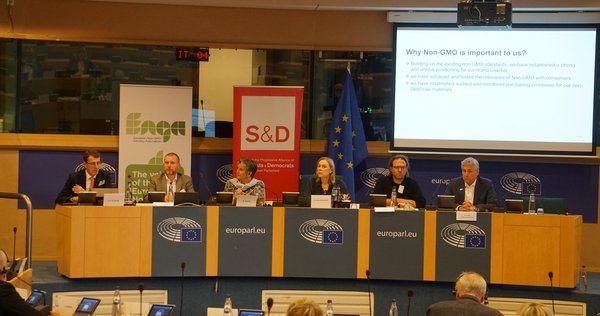
The Future of Non-GMO Food Production in the EU - The Video
News
Statement from ENGA: AGRIFISH Council
News
Leading representatives of the food retail industry: Proposed EU legislation on new genomic techniques must not jeopardize consumer choice, organic farming, and food price stability.

News
Raising the Voice of the Non-GMO Food Sector to the European Parliament
News
European Parliament and Member States at odds over New GMOs
News
New Genomic Techniques – time for the European Parliament to stand up for its citizens
News
Draft rapporteur’s report on New Genomic Techniques “an affront”

News
White Paper: Commission’s proposal requires wholesale improvement
News
NGT deregulation proposal – GMO-free food production at risk
News
Press release: Deregulation of New Genomic Techniques – GMO-free agriculture and food production is at stake
News
Letter to European Commissioners: The leaked legislative proposal to deregulate new genomic techniques
News
ENGA comment on leaked European Commission proposed NGT deregulation
News
Deregulation of New Genomic Techniques – what is at risk?

News
Deregulation of new GMOs: Raising resistance in the EU, Bill adopted in England

News
ENGA in the media – why New GMOs need to be strictly regulated

News
GMO-Free Conference in the European Parliament, Brussels

News
Ten things the food industry should know about New GMOs: Number 10
News
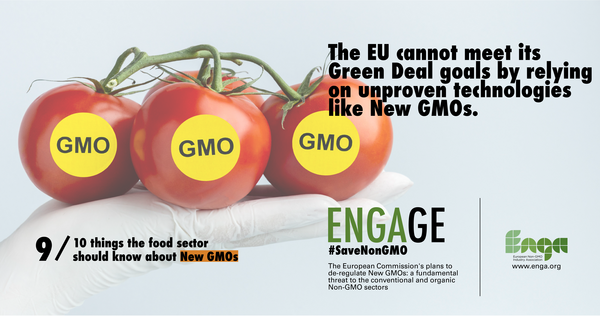
Ten things the food sector needs to know about New GMOs: Number 9
News
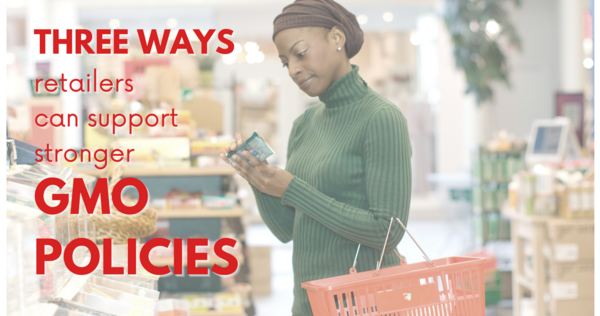
60+ Organisations Join Forces to call on UK and EU Supermarkets to take action against deregulation of New GMOs

News
European Commission publishes summary report on public consultation on New Genomic Techniques

News
The advantages of current EU GMO legislation

News
Joint letter urges retailers to take action against the weakening of regulation of new GMOs

News
Open letter: European Commission's biased road to deregulation of New GMOs
News
10 Things the Food Sector Needs to Know About New GMOs: Number 8
News
10 Things The Food Sector Needs to Know About New GMOs: Number 7
News
Why New GMOs are GMOs according to EU law – the European Court of Justice ruling

News
What terms are used for New GMOs and why?
News
10 Things The Food Sector Needs to Know About New GMOs: Number 6
Final call to participate in the European Commission’s consultation on New Genomic Techniques
News
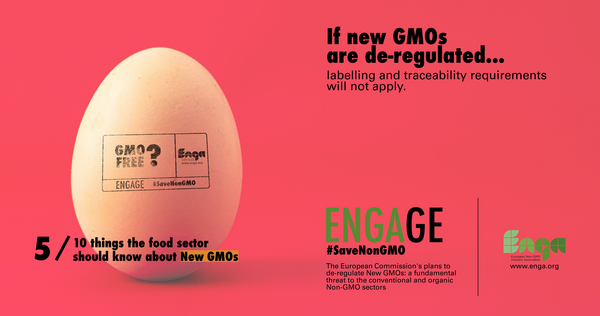
10 things the food sector needs to know about New GMOs: Number 5
News
New GMOs: only 3 products on the market and very little detail on success

News
10 things the food sector needs to know about New GMOs: Number 4

News
New GMOs - what is the consumer response?

News
10 things the food sector needs to know about New GMOs: number 3

News
10 things the food sector needs to know about New GMOs: number 2

News